
by Christopher Bodmann
It didn’t feel like a turning point at the time. But hindsight, as we all know, tends to bring clarity to these things.
Let’s back up…
As an author, I’m often pitched by people—mostly marketers—trying to sell me various services. I usually ignore them, but one email happened to mention Kid Comet, my middle-grade superhero adventure series. The person on the other end was seeking to help me improve my novels’ marketing descriptions on Amazon and other platforms. My interest was piqued.
I opened the Amazon listings to review what I had. The descriptions weren’t bad, but I knew they weren’t effectively pulling in readers or clearly signaling who the books were for, as evidenced by my—ahem—lackluster sales.
So I decided to work with the marketer to revise them.
We dove headlong into Amazon ads. Keywords. Targeting. Bid strategies. The rabbit hole was never-ending.
Everything was going great, but as Mike Tyson famously said, “Everybody has a plan until they get punched in the mouth.”
The “punch,” in my case, was thrown by none other than my own publisher. I was stunned to learn they weren’t going to help with the positioning or the ad strategy. They weren’t going to go through ad testing and iteration. They weren’t going to invest in the long-term growth of the series.
It wasn’t that my publisher didn’t care. It was that they were simply too overwhelmed with other books and authors.
I realized that if I wanted Kid Comet to succeed, the responsibility sat squarely on my shoulders.
A Listing and a Hope
This episode got me thinking. Why do publishers bother listing books if they aren’t going to stand behind them and take the time to lift them up? If authors are expected to carry the weight of discovery, marketing, and growth—on top of writing the books—what exactly is the system built to do?
Once I recognized this in my own experience, I started seeing it everywhere I looked.
Sadly, many authors put years into their work, only to see it dumped in a market with little more than a listing and a hope. Marketing is treated as an afterthought. In such cases, success can feel incidental rather than intentional.
To be clear, I didn’t believe publisher apathy was to blame. The industry is full of professional, hardworking people who go above and beyond in their roles, from editors to designers to agents.
The problem, I was convinced, was the system itself.
Make Your Own Spaghetti Stick
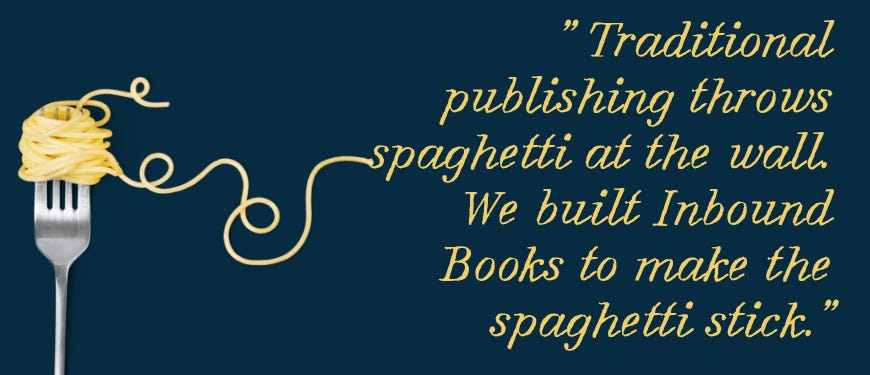
Why do I say the system is the problem? Because it wasn’t built around sustained support or long-term growth for most books. Instead, it was built around volume. The industry throws spaghetti at the wall, and on the off chance they find something that sticks, that’s what they support. The thinking seems to be that 95% of released books will fail, so why waste time and money supporting them?
This doesn’t make anyone a villain. It just means that, more often than not, authors must make their own spaghetti stick.
To be perfectly blunt, I think that sucks. As a marketer, it’s a pill I’ve had a hard time swallowing. I get that not all marketing is going to produce runaway results, but leaving success to chance is, by any measure, a terrible business model. That’s especially true when the tools that can help a book succeed in the marketplace are widely available.
With that in mind, I asked myself some questions:
- What would it look like if the system was designed differently?
- What if intentionality was baked in from the start?
- What if the publisher’s work didn’t end at book launch but extended into helping that book find its audience?
- What if authors weren’t isolated from one another, each trying to reinvent marketing strategies on their own?
- What if there were shared systems, shared knowledge, shared momentum?
- What if success wasn’t left to chance?
Inbound Books was built on these questions and the proposition that intentionality can pay off.
The Co-op Model
At its core, our idea is straightforward: publishing should be both creative and strategic. A book shouldn’t just exist; it should be positioned to find the right readers. Authors shouldn’t have to figure that out on their own. The publisher and author have what should be a mutually beneficial partnership. With Inbound, we set out to create a system that treats it as such.
That system is the cooperative, or co-op, model.
One of the most overlooked aspects of the traditional model is how siloed everything is. Each author operates in their own lane, often solving the same problems as everyone else, but without shared visibility or collaboration.
Inbound Books leans into the opposite idea that authors should support and learn from each other and benefit from shared infrastructure.
What does this look like? It might look like shared insights into what’s working on Amazon. It might look like collaborative promotion. It might be taking advantage of scale and scope that larger groups can provide. Net-net, authors won’t have to start from zero every time they approach something new.
What I Wish I’d Known Before My Book Launch
Looking back at my own experience with Kid Comet, there are a few things I wish I’d understood more clearly before the book launch.
For starters, when a book goes live, the listing is more than a formality. It’s often the first and only impression a reader gets before deciding whether to click buy.
The listing, in other words, is the front door, and it needs a really compelling welcome mat.
In an ideal world, a good publisher should treat that listing as a core asset—something that’s crafted with intention, tested, and improved over time. Not something static. Not something “good enough.”
Something else I wish I’d understood better is visibility.
This might come as a news flash, but books don’t succeed simply because they exist. They need to be seen by the right readers, repeatedly, and in the right contexts. That requires a plan, whether through ads, partnerships, or other channels. Probably all of the above.
In short, authors shouldn’t have to guess how to proceed. They should be part of a system where visibility is actively built, not passively hoped for.
Growth is Cumulative
And then there’s the longer arc.
A book launch is a single moment in time. A book’s shelf life, on the other hand, is much longer than that.
Too often, support (if you get any) fades after launch as attention shifts to new releases. But for many books—especially in middle-grade and series fiction—growth is cumulative. It builds over time, through consistency, discovery, and word of mouth.
One of the keys to this kind of growth is collaboration. When you’re working alone, every gain feels fragile. Every experiment carries more risk. Progress is possible, but it’s slower and more uncertain.
In a collaborative setting, the dynamic shifts. Insights compound. Strategies evolve faster. Wins in one area can inform progress in another.
It becomes less about any single book succeeding in isolation and more about building a system where success is more likely, more repeatable, and more sustainable. A rising tide lifts all boats, as the expression goes.
Great Stories Deserve a Real Shot
For all the talk of systems and strategy, the heart of this is still storytelling. That part never changes. Kid Comet didn’t start as a marketing exercise. It started with a character, a voice, and a story I believed kids would enjoy.
That’s still the job.
But getting the story written is only half of it. If we want books to matter—if we want them to reach the kids who need them, the readers who will carry them forward—then we have to take the other half just as seriously.
We have to be just as intentional about how stories are discovered as we are about how they’re told. That’s the gap Inbound Books was built to close.
I don’t think the industry is broken beyond repair. I think it’s incomplete.
And I know it can be better—more deliberate, more collaborative, more effective for the people actually doing the work.
Inbound Books is our attempt to build in that direction.
If this resonated with you, whether you’re an author, a reader, or someone who just believes great stories deserve a real shot, come check us out. You can learn more at inboundbooks.org.
Christopher Bodmann writes engaging stories that blend fantasy with real-world issues for readers of all ages. Passionate about inspiring a love of reading, he creates relatable characters and meaningful themes that connect with broad audiences.
Leave a Reply